
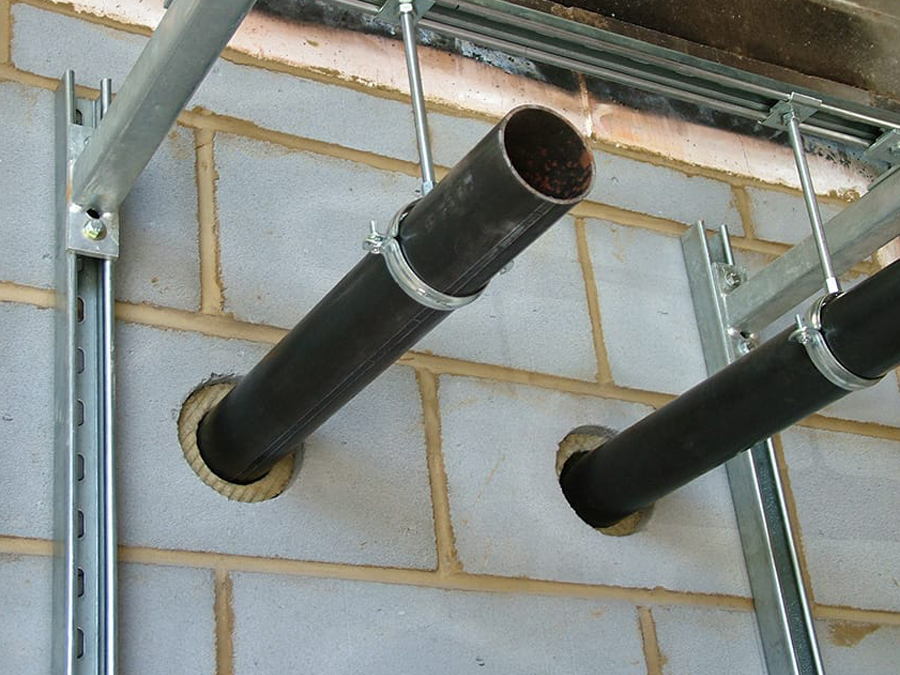
Full Scale Testing Vertical Elements
Exposed Area 3.0(h) x 3.0(w)m
The test method determines the system of test and criteria for the evaluation (including field of application rules) of the ability of a penetration seal to maintain the fire resistance of a separating element at the position at which it has been penetrated by a service.
The test method determines the system of test and criteria for the evaluation (including field of application rules) of the ability of a penetration seal to maintain the fire resistance of a separating element at the position at which it has been penetrated by a service.
Penetration seals used to seal gaps around chimneys, air ventilation systems, fired rated ventilation ducts, fire rated service ducts, shafts, and smoke extraction ducts are excluded from this standard except for mixed penetration seals.
The fire resistance of those services itself cannot be assessed with the methods describes in this standard.
Supporting constructions are used in this standard to represent separating elements such as walls or floors. These simulate the interaction between the test specimen and the separating element into which the sealing system is to be installed in practice.
To carry out an accredited test to BS EN 1366-3:2021.
On request, dependent on your requirements for:
Once you’ve booked a test, you can expect to receive a Test Date Booking Form – securing the booking date and agreeing the timeline for delivery and installation.
Closer to the time, we’ll ask you to complete a Customer Test Details Form, to confirm the exact details of the test. At this point we’ll also ask you to submit a full technical specification and CAD drawings in .dwg format. We will review the proposed construction to ensure compliance with the test standard.
The wall sample can be built by the test sponsor, or by our in-house build team – mechanically fixed within one of our 3m x 3m furnace restraint frames. During construction a member of our technical team will comprehensively document the materials and methods of construction, consult with the builders to ensure all requirements of the test standard are met, and apply any internal thermocouples as required.
If required, our in-house build team can prepare in advance a supporting construction to reduce the size of the opening to suit your needs.
The test takes place within a test construction, mechanically mounted to a restraint frame and hung on the front of a 3m high x 3m wide or 2.4m high x 1.35m vertical furnace – representing a compartment wall in practice. Alternatively, the test construction can be mounted to a restraint frame and positioned on the top of a 1.4m wide x 1m deep horizontal opening on the furnace.
The test is carried out to the Standard temperature-time heating curve ISO 834, also known as the Cellulosic curve and to the pressure conditions as described in BS EN 1363-1:2020.
Common durations for this test methodology are 30 minutes, 60 minutes, 90 minutes, 120 minutes, 180 minutes and 240 minutes – each including a nominal overrun period intended to directly extend a products field of application.
The penetrations seals are evaluated by the times in completed minutes for which the test specimen continues to maintain its separating function during the test without:
The criteria are not applied to the uncapped pipe ends. Failure of any cable in a cable group as defined in Table A.1 fails the whole group.
Insulation will be evaluated by the time in completed minutes for which the test specimen continues to maintain its separating function during the test without developing temperatures on its unexposed surface which:
Failure of any cable in a cable group as defined in Table A.1 fails the whole group.
Exposed Area 3.0(h) x 3.0(w)m
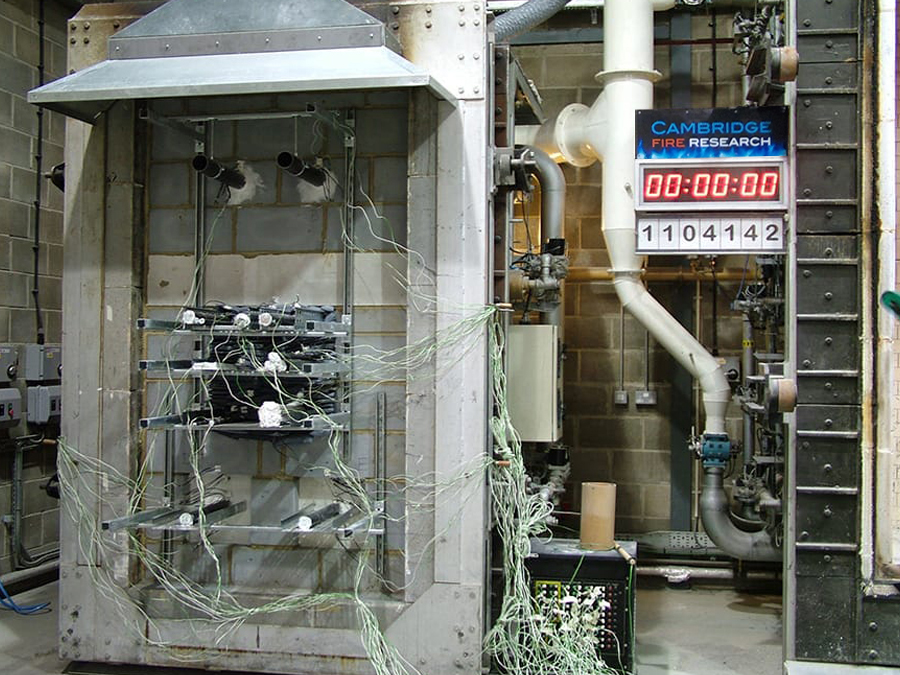
Exposed Area 2.4(h) x 1.35(w)m
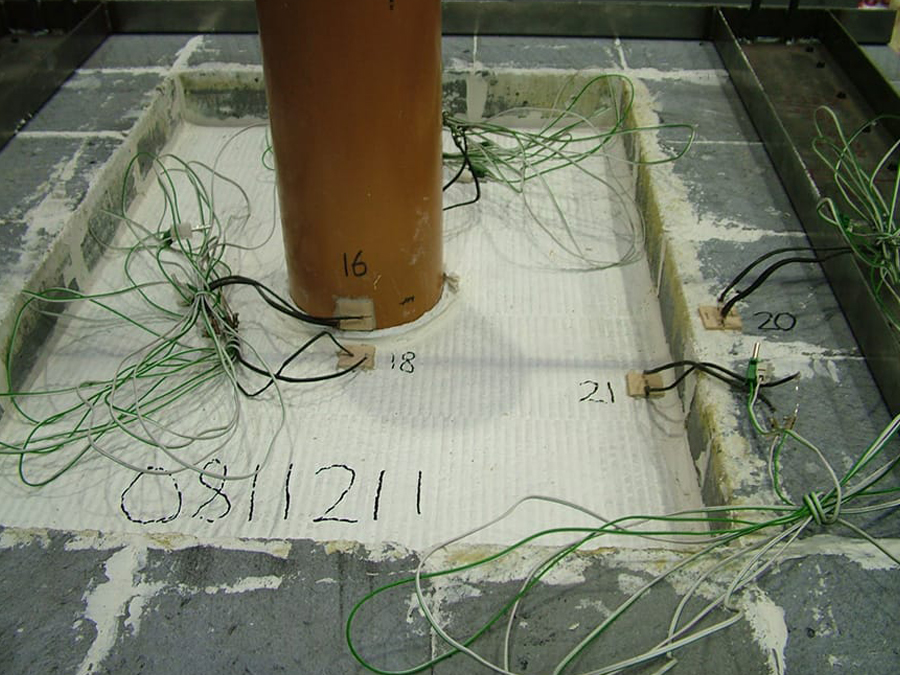
Exposed Area 1.4(h) x 1.0(w)m
If required, CFR may be able to assist with procuring materials and specimen installation – Please enquire for details.
Get in touch or find us en route