
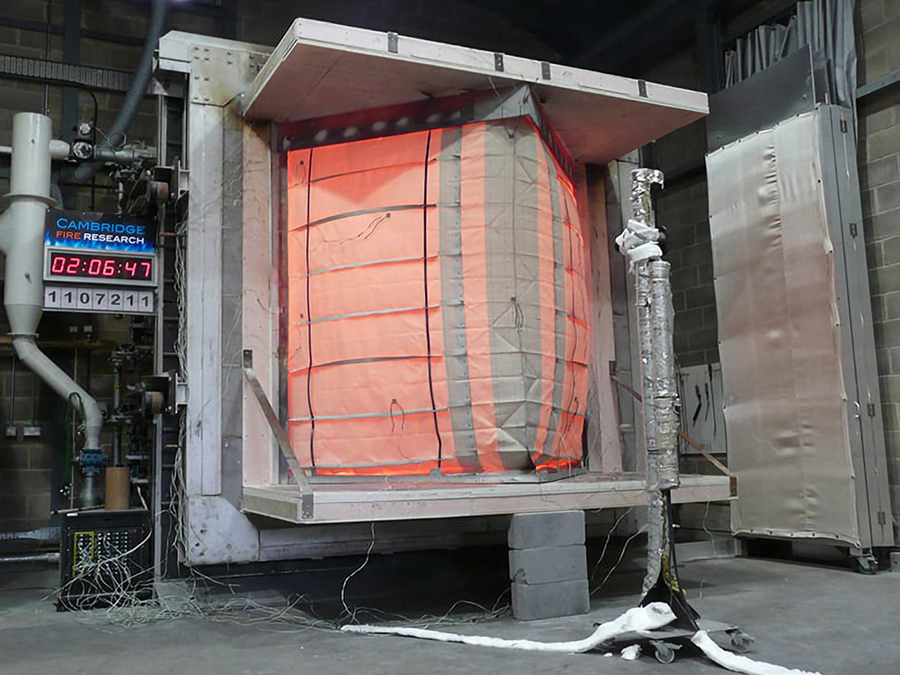
Full Scale Testing Vertical Elements
Exposed Area 3.0(h) x 3.0(w)m
Ongoing product development and evolving standards may require indicative fire testing based on existing standards or custom regimes.
Due to the on-going nature of product and/or application development, and the ability of product/test standards and guidelines to keep up, scenarios can often occur whereby it is necessary to undertake indicative fire testing to the general principles of an existing standard or perhaps even to a bespoke ad-hoc regime.
Often too it will be required to verify a relatively minor constructional or component change from the specification in a previous test. Such evidence can prove invaluable for the purpose of product certification and increasing scope of approval.
We’re happy to support you with your indicative and ad-hoc testing, please contact us to discuss your requirements.
On request, dependent on your requirements for:
• Test duration
• Installation / Construction
• Additional measurements or instrumentation
• Reporting
Once you’ve booked a test, you can expect to receive a Test Date Booking Form – securing the booking date and agreeing the timeline for delivery and installation.
Closer to the time, we’ll ask you to complete a Customer Test Details Form, to confirm the exact details of the test. At this point we’ll also ask you to submit a full technical specification and CAD drawings in .dwg format.
The wall sample can be built by the test sponsor, or by our in-house build team – mechanically fixed within one of our 3m x 3m furnace restraint frames. During construction a member of our technical team will comprehensively document the materials and methods of construction.
If required, our in-house build team can prepare in advance an associated construction to reduce the size of the opening to suit your needs.
The sample is prepared for testing – measurements are taken, an array of thermocouples affixed, and positions marked for measurements to be taken during the test.
The frame is then mounted on the front of our 3m high x 3m wide vertical furnace so that one face of the sample is exposed to the fire – representing a compartment wall in practice.
The sample is evaluated for 2 criteria:
The result for each criteria is expressed as the number of whole elapsed minutes for which the sample maintains that ability.
Integrity is evaluated by:
Insulation is evaluated by:
Irradiance and lateral deflection are also measured and reported against the total number of elapsed minutes.
Exposed Area 3.0(h) x 3.0(w)m

Exposed Area 2.4(h) x 1.35(w)m
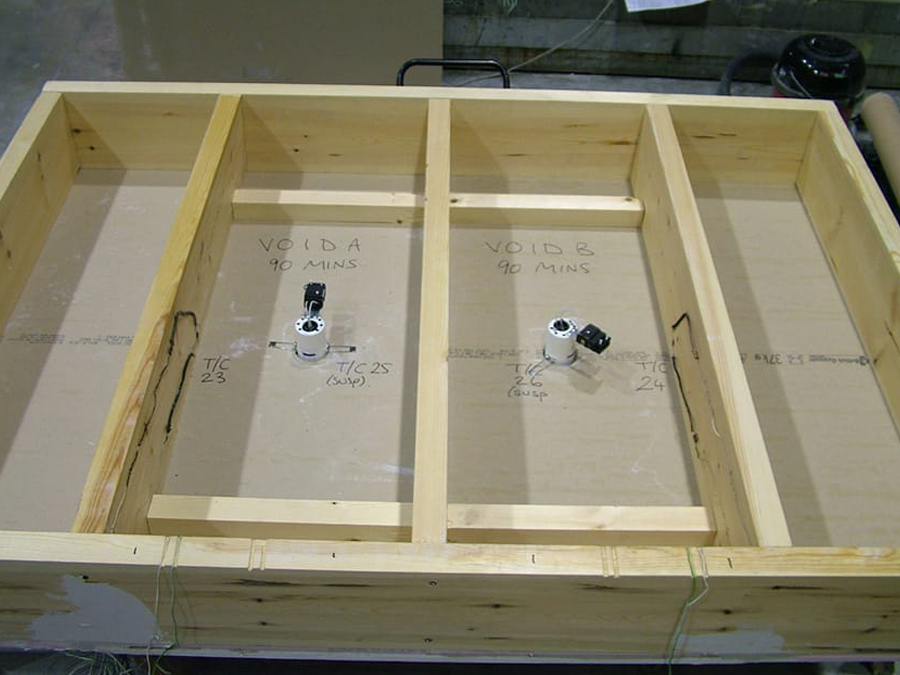
Exposed Area 1.4(h) x 1.0(w)m
If required, CFR may be able to assist with procuring materials and specimen installation – Please enquire for details.
Get in touch or find us en route