
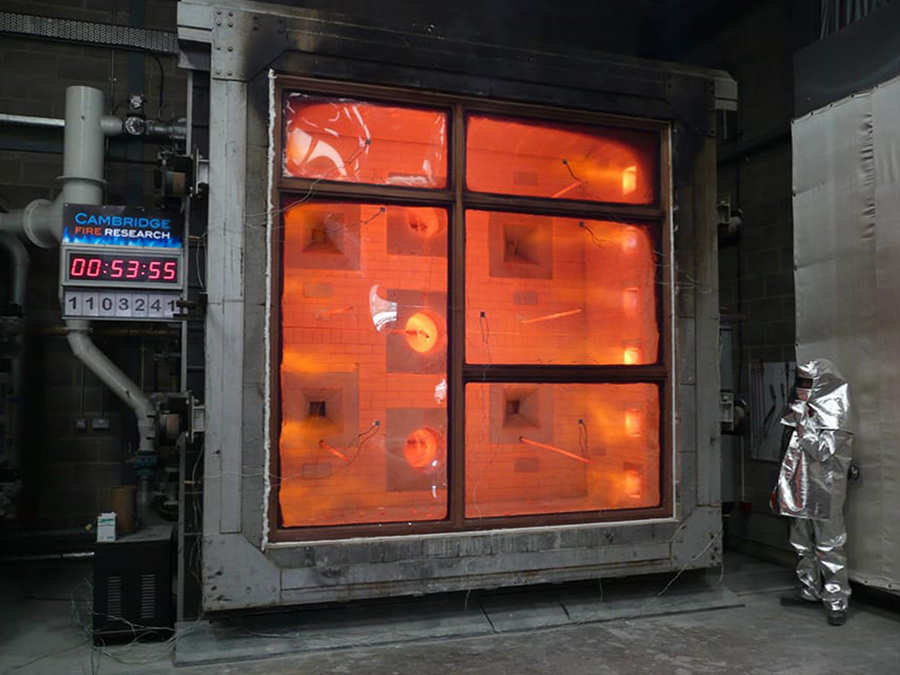
Full Scale Testing Vertical Elements
Exposed Area 3.0(h) x 3.0(w)m
The test method determines the fire resistance of non-loadbearing elements of building construction when subjected to the heating and pressure conditions specified in BS 476-20:1987.
The test method determines the fire resistance of non-loadbearing elements of building construction when subjected to the heating and pressure conditions specified in BS 476-20:1987.
BS476-22:1987 is applicable to vertical partitions, fully insulated, partially insulated and uninsulated vertical doorsets and shutter assembles (except fire dampers incorporated in ducts), ceiling membranes and to glazed elements.
To carry out an accredited test to BS 476: Part 22.
On request, dependent on your requirements for:
• Test duration
• Installation / Construction
• Additional measurements or instrumentation
• Reporting
Once you’ve booked a test, you can expect to receive a Test Date Booking Form – securing the booking date and agreeing the timeline for delivery and installation.
Closer to the time, we’ll ask you to complete a Customer Test Details Form, to confirm the exact details of the test. At this point we’ll also ask you to submit a full technical specification and CAD drawings in .dwg format.
Delivery of the doorsest will be suitably ahead of the test date. A member of our technical team will comprehensively document the materials and methods of construction of the doorset and its component parts, independently verifying it against the supplied specification.
Our in-house build team will prepare an associated wall construction within one of our furnace restraint frames, with openings for the doorsets to be installed into.
The doorset can be installed by the test sponsor or by one of our in-house installers. A member of our technical team will document the installation process, recording details and measurements as necessary.
The test takes place within or without a test construction, mechanically mounted to a restraint frame and hung on the front of a 3m high x 3m wide vertical furnace – representing a compartment wall in practice.
The test is carried out to the Standard temperature-time heating curve ISO 834, also known as the Cellulosic curve and to the pressure conditions as described in BS 476-20:1987.
Common durations for this test methodology are 30 minutes, 60 minutes, 90 minutes, 120 minutes, 180 minutes and 240 minutes – each including a nominal overrun period (not required by the standard but included).
Where a specimen is designed with more than 50% of its surface area consisting of glazing, there is one method within BS 476-22:1987 applicable to glazed elements:
The glazed elements are evaluated by the ability to contain a fire to specified criteria for collapse, freedom from holes, cracks and fissures and sustained flaming on the unexposed face in the total number of elapsed minutes.
Insulation will be evaluated in the total number of elapsed minutes.
Radiation/irradiance will be measured and reported against the total number of elapsed minutes.
Exposed Area 3.0(h) x 3.0(w)m
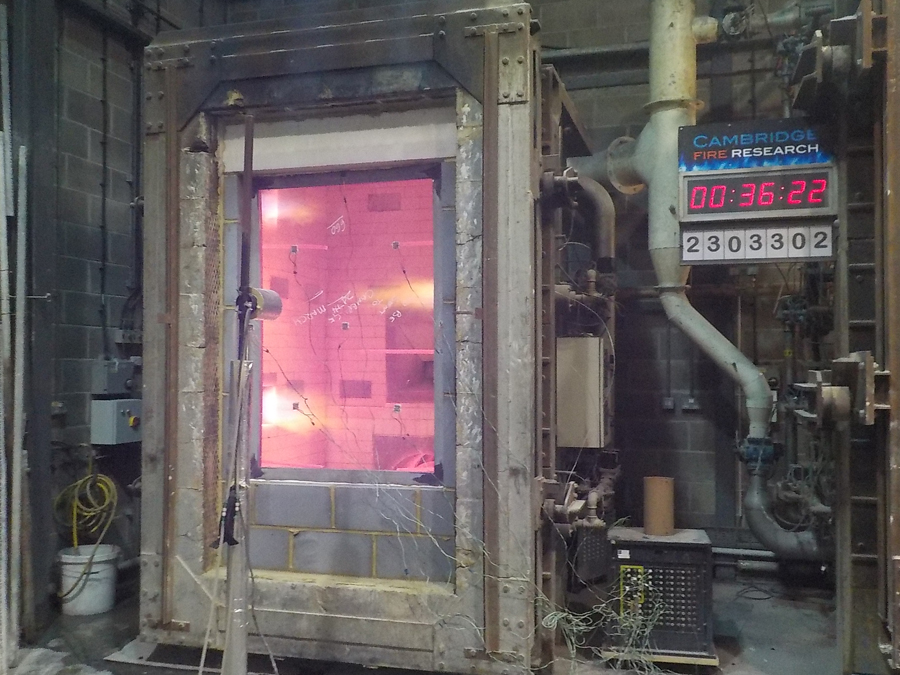
Exposed Area 2.4(h) x 1.35(w)m
If required, CFR may be able to assist with procuring materials and specimen installation – Please enquire for details.
Get in touch or find us en route